


Why First Aid Kit Size Matters
Most small business owners maintain basic first aid supplies on-site, but few know if their inventory complies with safety standards. Facility headcount, hazard severity, and operational risk profiles all dictate adequate supply levels. Non-compliance leaves employees vulnerable and exposes organizations to regulatory penalties.
Meeting OSHA mandates requires balancing federal standards with ANSI kit classifications. Learn more about selecting the appropriate kit class to protect personnel and keep facilities audit-ready.
OSHA’s First Aid Requirements
OSHA’s general industry standard (29 CFR 1910.151) requires that adequate First Aid supplies be readily available in any workplace not near a medical facility. Because OSHA does not prescribe exact supply lists, it points employers to ANSI/ISEA Z308.1 as the recognized minimum guideline. That standard is where kit class and size decisions start.
ANSI/ISEA Z308.1 classifies workplace First Aid supplies into two groups, Class A and Class B, based on the type of work being performed and its associated hazard level rather than the number of employees on site. Class A kits are designed for low-risk, common workplace environments, while Class B kits are intended for high-risk or complex work areas where injuries are more likely or more severe. The first step in determining what your facility needs is identifying the nature of the work being done, not counting heads.
Employee count isn’t irrelevant; it plays a role in how many First Aid kits you need and where they’re placed, but it doesn’t determine First Aid kit class. What matters most is that First Aid supplies are readily available to every employee, regardless of facility size. A 10-person machine shop has a very different risk profile than a 10-person marketing office, and the standard is built around that distinction, not headcount alone.
Class A 21 for Low-Risk Environments
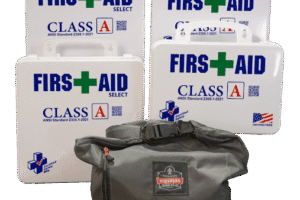
Class A 21 First Aid kits address common workplace injuries like minor cuts, abrasions, minor burns, and light eye irritations. These First Aid kits provide the baseline ANSI-compliant supply assortment for facilities with minimal operational hazards.
Class A kits serve standard commercial workplaces with minimal exposure to severe hazard environments. A few common Class A applications include:
- Office buildings and retail storefronts
- Educational facilities and administrative suites
- Light warehousing and commercial service centers
These First Aid kits meet the minimum ANSI-compliant supply assortment and remain straightforward to maintain. When selecting a First Aid kit for small business operations in these settings, a Class A 21 cabinet sized to your headcount provides an effective baseline. For low-risk desk-based teams, analyzing how many employees a First Aid kit can safely cover protects against sudden shortages.
Class B 21 for High-Risk Work Zones
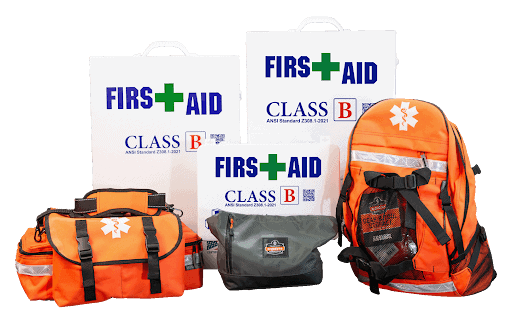
Class B 21 First Aid kits carry the same core supplies as Class A 21, but in greater quantities and with additional items suited to complex injuries. They feature gasketed, weather-resistant enclosures appropriate for outdoor or industrial environments.
Class B kits are engineered for high-risk operations requiring expanded supply volumes and specialized injury-response tools. Facilities, such as the ones below, require Class B configurations when operating in high-hazard environments:
- Heavy manufacturing, fabrication, and construction sites
- Facilities handling chemical processing or hazardous materials
- Workspaces with high-heat processes, heavy machinery, or fall exposures
- Remote job sites subject to delayed emergency medical response
Class B 21 First Aid kits also support bloodborne pathogen compliance under OSHA 1910.1030. Workplaces with potential exposure to blood need First Aid kits with CPR barriers, biohazard bags, and extra gloves. Standard Class A 21 First Aid kits do not cover these items.
Quick-Reference Chart
To help streamline your procurement workflow, the table below maps common workplace environments to their corresponding safety requirements:
| Business Type | Risk Level | Recommended First Aid Kit |
| Office, retail, school | Low | Class A 21 |
| Light warehouse, distribution | Low-Moderate | Class A 21 or Class B 21 depending on hazard assessment |
| Manufacturing, fabrication | Moderate-High | Class B 21 |
| Construction, outdoor, remote | High | Class B 21, weather-resistant |
| Any workplace with bloodborne pathogen exposure | Varies | Class B 21 with bloodborne pathogen supplies |
Headcount alone does not determine kit placement. Multi-story facilities and multi-building campuses require distributed kits to maintain emergency accessibility. Under ANSI guidelines, any response layout requiring more than 60 seconds to access supplies mandates an additional first aid station.
Custom Compliance Solutions at Certified Safety
Managing first aid inventories internally creates operational risks, including unmonitored stock depletion and expired items. Partnering directly with a single-source safety manufacturer streamlines replenishment while maintaining continuous audit readiness.
Sourcing directly from Certified Safety provides full material traceability and direct compliance support. Our technical teams evaluate facility layouts to determine precise headcount coverage and kit distribution across multi-zone manufacturing environments.
Simplify Facility Compliance with Certified Safety
Aligning ANSI kit selection with operational risk and facility headcount requires exact technical parameters. Partner with Certified Safety to audit your facility layout, select the correct Class A or Class B configurations, and maintain long-term compliance.
Contact one of our First Aid specialists for custom compliance support.